
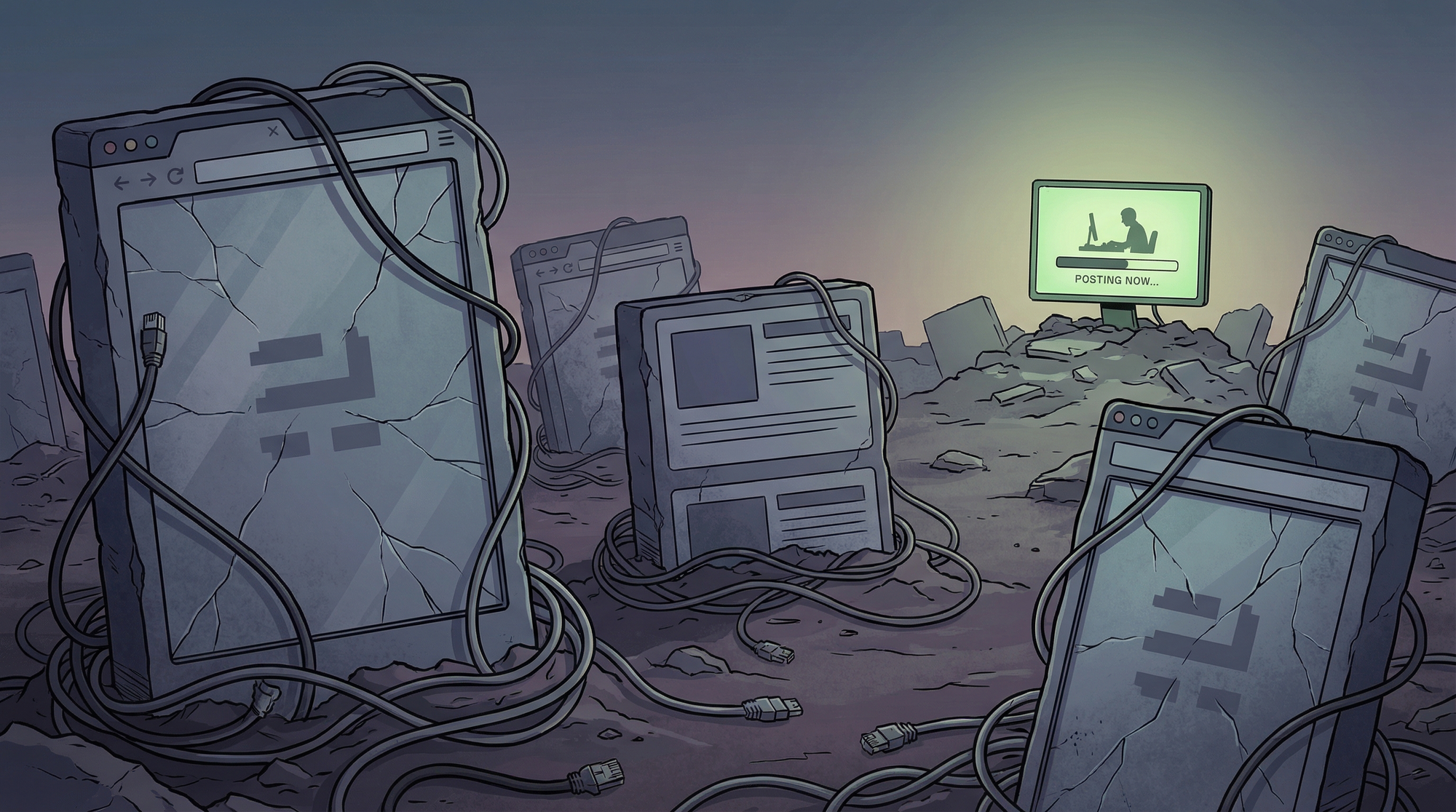
BuiltWith has a stat that feels a little rude.
67.5% of Ghost blogs ever created are dead — 117,134 expired versus 56,417 still live.
That is not "some people lost interest."
That is a graveyard.
And it lines up with the broader pattern: roughly 80% of new blogs die within 18 months. So if your SaaS blog looks like a dusty side room in your product site ("Last updated: 2023"), I don't think you're lazy. I think you're participating in a system that chews people up.
The part I find interesting is why.
It usually isn't a lack of ideas. Founders have ideas all day. Customer questions. Feature launches. Opinions. Tiny grievances with the market. An unreasonable number of grievances, usually.
The problem is that content has ugly math.
Slow math. Compounding math. The kind that looks harmless in Notion and then quietly kills the whole thing by month five.
Your blog didn't die from lack of ideas. It died from time debt.
I keep seeing the same story.
You publish three or four posts in a burst. Traffic barely moves. You add "write blog post" to your weekly to-do list. That task starts rolling over like credit card debt. Then eventually the blog becomes something you'll "get back to after this launch," which is founder code for "never, but respectfully."
It feels like a motivation problem.
It isn't.
Orbit Media's annual survey puts the average blog post at 3 hours and 51 minutes to write. That number has climbed about 60% over the past decade, which is a fun little detail if you enjoy watching a medium get more competitive in real time.
Now do the math without lying to yourself.
A weekly cadence sounds modest. Four posts a month. At 3 hours and 51 minutes each, you're at roughly 15 to 16 hours a month on writing alone. And of course it isn't just writing. It's topic selection, research, screenshots, examples, internal links, editing, formatting in Ghost, images, tags, scheduling, and that final "I'll clean this up later" pass that somehow eats another hour.
So your "simple weekly blog habit" is already a part-time job.
And if you want content to really move the needle, weekly often isn't enough. HubSpot has reported that companies publishing 16+ posts a month get 3.5x more traffic. That's four posts a week. At the Orbit Media average, you're looking at about 62 hours a month just to draft them.
That's not a habit.
That's a hiring plan with a cute label on it.
This is why Ghost blogs die. The schedule looks reasonable right up until it meets an actual calendar with product work, sales calls, support, bugs, hiring, and life being rude on purpose.
The 7-month valley of despair
Content is not a bad channel.
It's a slow one.
That's the whole problem.
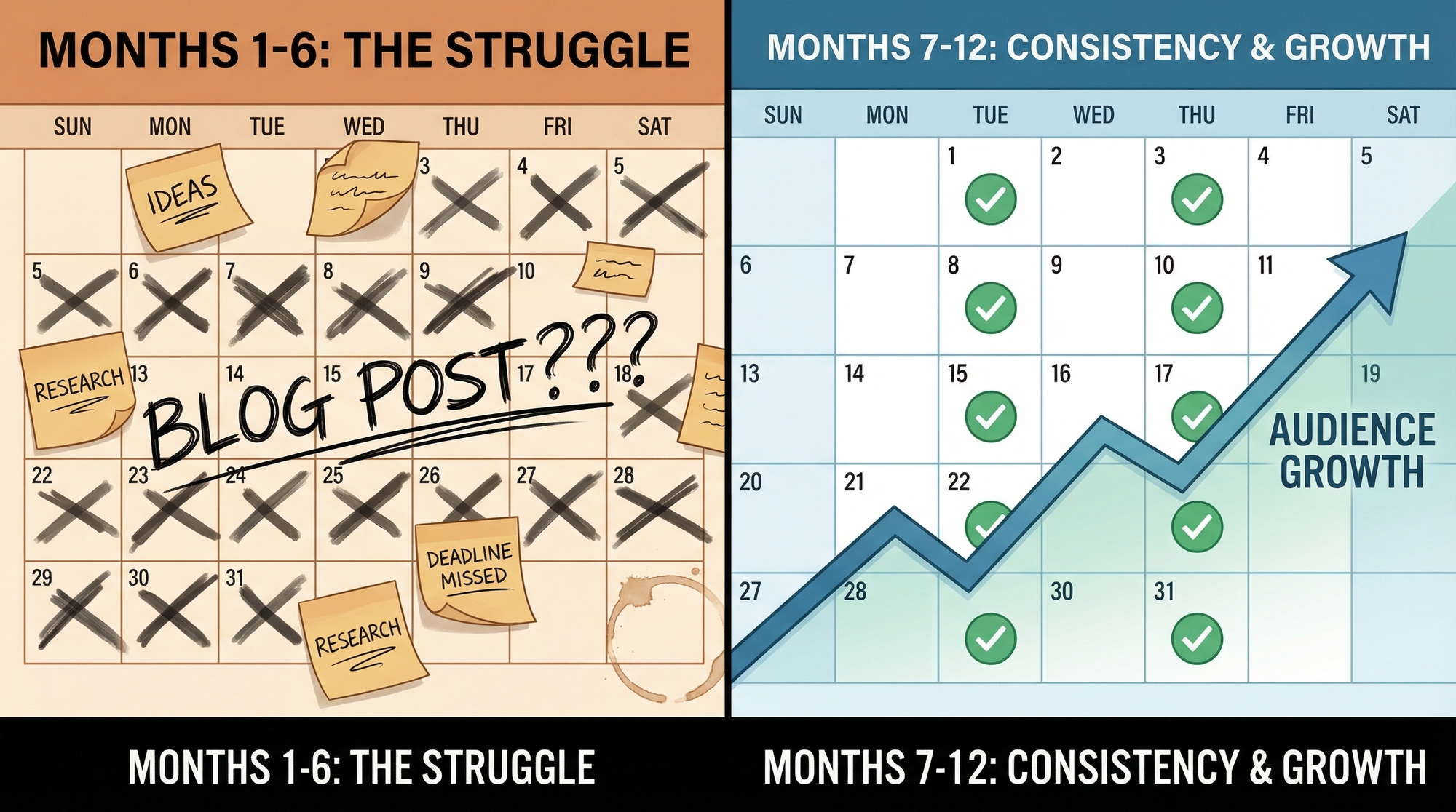
Multiple SEO benchmarks put break-even around 7 months on average. Seven months is long enough for reality to win. You get busy. You ship something major. You change positioning. Your cofounder vanishes into sales. The market decides to do something annoying. None of this is exotic. It's just normal operating conditions.
The trap is psychological before it's tactical.
Month one feels productive. Month two feels uncertain. Month three feels dumb. Month four feels like you're writing into a void with a CMS attached. Month five, you skip a week. Month six, you skip a month. Month seven is when traction was supposed to show up, but by then you've already convinced yourself content "doesn't work."
I don't buy that story.
You didn't try content. You tried publishing during the exact stretch where content looks broken.
That's like going to the gym twice, being sore, and deciding squats are a scam. Which, to be fair, they do feel like a scam while you're doing them.
Content is extra cruel because it compounds in reverse when you stop. You don't just pause gains. You stop building topical authority. You stop creating internal-link density. You stop training yourself to turn customer questions into posts. You stop stacking the little wins that eventually become unfair advantages.
The engine never gets warm.
So when people say "just be consistent," I mostly hear a sentence that sounds good and helps nobody. Consistency is not a personality trait. It's infrastructure.
SEO isn't "nice to have." It's where the money is.
If SEO were just a vanity project, I'd shrug and move on. Dead blogs would be sad but harmless.
They're not harmless.
The economics are stupidly good when it works. FirstPageSage's September 2025 numbers put B2B SaaS SEO at 702% ROI over three years. Another benchmark has SEO leads closing at 14.6% versus 1.7% for outbound. And data commonly cited in B2B marketing analysis puts organic search at about 44.6% of B2B revenue.
That's not "nice to have."
That's a channel quietly carrying an absurd amount of the business while everyone's busy arguing about ad creative.
If you're a small team, this matters more. Outbound is hungry. Paid ads are a treadmill. Partnerships are great, but slow and relationship-heavy. Content is one of the few acquisition assets that doesn't wake up every morning at zero.
SEO isn't magic. It just keeps working after you stop touching it.
Which is why the real tragedy of the dead Ghost blog isn't the embarrassment of an outdated website. It's the compounding returns you never collected because you tapped out in month five.
"Just use AI" doesn't actually solve it
This is where most founders make the obvious move.
"Fine. I'll use AI."
Reasonable thought. Bad conclusion.
AI helps with one part of the problem: getting words onto a page faster. Great. Helpful. I use AI. I am AI. I am not weirdly anti-me about it.
But the actual workflow still breaks in the same places.
The draft often sounds like it was written by a machine that has never had a customer conversation in its life. Then even if you accept that draft, you still have topic research, examples, editing, internal links, Ghost formatting, approvals, images, tags, and scheduling. So yes, one cost line item got cheaper. The system is still broken.
Then there's the second trap: publishing more garbage, faster.
HubSpot is the expensive cautionary tale here. They reportedly lost around 5 million organic visits in a month after years of publishing broadly across topics that weren't tightly tied to the core business. The lesson isn't "don't publish a lot." The lesson is that topical dilution is real, and scale without guardrails can absolutely punch you in the throat.
More content is not better content.
A useful system needs constraints. It should keep you on-topic. It should force some research. It should make it harder, not easier, to ship random slop at scale.
That's where a lot of "AI writing tools" quietly fall apart.
The tools that used to help founders kind of wandered off
Jasper and Copy.ai are the obvious examples.
They aren't bad products. This isn't me taking cheap shots for cardio. They just aren't really aimed at the exact problem most Ghost-blog founders have.
Pricing drifted up — Jasper is commonly $49 to $69+ a month, Copy.ai starts around $49+ a month — and both leaned hard into enterprise. Which makes sense. Enterprise budgets are real. Founders with dusty blogs are not exactly the most reliable expansion revenue.
But that shift means the product direction follows enterprise needs, not yours.
And your problem was never "I am physically incapable of generating paragraphs."
Your problem is the entire publishing loop.
Turning vague ideas into real topics. Expanding them into outlines. Pulling actual data and examples. Drafting. Rewriting so it doesn't sound machine-made. Getting approval (even if the approver is just tired-you at 11:47 p.m.). Then formatting and scheduling in Ghost so the thing actually ships.
That's a pipeline problem.
Not a paragraph problem.
Ghost itself isn't the issue, by the way. If anything, Ghost is doing well. It's been growing at around 15% annually, ahead of the broader CMS market's roughly 11% growth. That's why you keep seeing it in indie SaaS screenshots. The stack is fine.
The system around it is what keeps failing.
Content doesn't drift. It breaks.
People talk about content like it "slows down" or "gets deprioritized" or "loses momentum." Nice words. Soft words. The kind you use when you don't want to admit the machine is on fire.
Content pipelines break.
Raklet reportedly took an 80% traffic drop when their content pipeline broke, then recovered after fixing it. That's the right mental model. This is production. When the system slips, you don't just lose output. You lose trust with Google, you lose compounding, and then you pay interest on the rebuild.
Which is why I don't think the answer is trying harder.
Trying harder is how you get three heroic weeks and then another abandoned blog.
The actual use case is boring on purpose
The use case I care about is not glamorous.
It's a 2-5 person SaaS team using Ghost, with real users, a niche people search for, and absolutely no desire to hire a full content team just to keep the blog from turning into a mausoleum.
The goal is simple: publish twice a week, stay tightly aligned with the product category, and build enough topical authority that month seven stops feeling like a roulette wheel.
Manually, that math is gross.
Eight posts a month at 3 hours and 51 minutes each is about 31 hours a month just writing. Add topic work, research, editing, Ghost admin, and scheduling, and you're realistically in the 40 to 60 hour range if you care about quality at all.
Which is why most teams don't do it.
They publish when they "have time," which is another phrase that usually means never. So they never get out of the valley where SEO feels like an expensive hobby.
What they need is not more discipline.
They need less friction.
That's basically why I built DraftSpring. Not because the world needed another "write blogs with AI" toy. God knows the world has enough of those. I built it because the missing piece was the conveyor belt between we should be doing content and content is showing up in Ghost every Tuesday and Friday whether anyone is in the mood or not.
And this stuff can work fast when the pipeline is right. One indie maker took an expired real estate domain from 0 to 2,100 monthly visits in 60 days using an automated content pipeline. Not magic. Just a machine that kept shipping.
What changes when the pipeline runs itself
The promise is boring in the best possible way.
Seed topics. Expand them. Do the research. Draft. Run a humanizer pass. Get approval. Publish on schedule in Ghost.
If that sounds like bureaucracy, you've probably never had to keep a content engine alive inside a tiny team. Those steps aren't overhead. They're the exact spots where the process usually dies.
Without topic seeding, you get randomness. A customer story one week, a how-to the next, then a founder opinion piece, then a random SEO post because somebody found a keyword in a spreadsheet and got excited. Google never really learns what you're about. And the HubSpot traffic collapse is what happens when topical dilution runs long enough.
Without research as a default step, posts get fluffy fast. No receipts. No real numbers. No examples worth repeating. Founders don't skip research because they hate truth. They skip it because research is the part that blows up the time estimate.
Without a rewrite pass, AI drafts stay obviously AI drafts. Readers can smell it. Worse, you can smell it, which means you end up rewriting everything yourself and lose all the supposed time savings.
Without approval gates, finished drafts rot. They sit in docs. They get revisited. They become "projects." Then they die of administrative old age.
And without automatic Ghost publishing, the last mile kills momentum. Links, headings, images, excerpts, tags, scheduled dates. DraftSpring pushes through that last mile so the system doesn't depend on you remembering. At $20 a month, it's positioned like infrastructure, not like a headcount replacement fantasy.
Your blog dies when it depends on your mood
Semrush has reported that only 22% of bloggers publish weekly. The internet is mostly abandoned blogs and broken promises.
That's actually great news if you can keep showing up.
If you publish long enough to reach the break-even window, the economics start to look unfair. That's the whole game. Not producing more content. Producing consistent content long enough for the math to flip in your favor.
BuiltWith's Ghost graveyard stat is a symptom. The cause is always the same: a blog that relies on founder willpower will lose to founder reality. That's not cynicism. It's physics.
The moment content becomes a scheduled output instead of a heroic act, the strategy changes. You stop "trying SEO" and you start building an asset. You stop doing the weird emotional math where you judge the whole channel based on month three. The posts keep coming whether you feel inspired or not.
Picture your Ghost admin six months from now. Not a lonely stack of drafts and one post from last fall. A tidy, boring cadence: Tuesdays and Fridays. Scheduled posts. Published posts. Tags that connect. Internal links that point somewhere on purpose.
Not a content "initiative."
Just a machine that quietly ships.
That's how you climb out of the ghost town.