
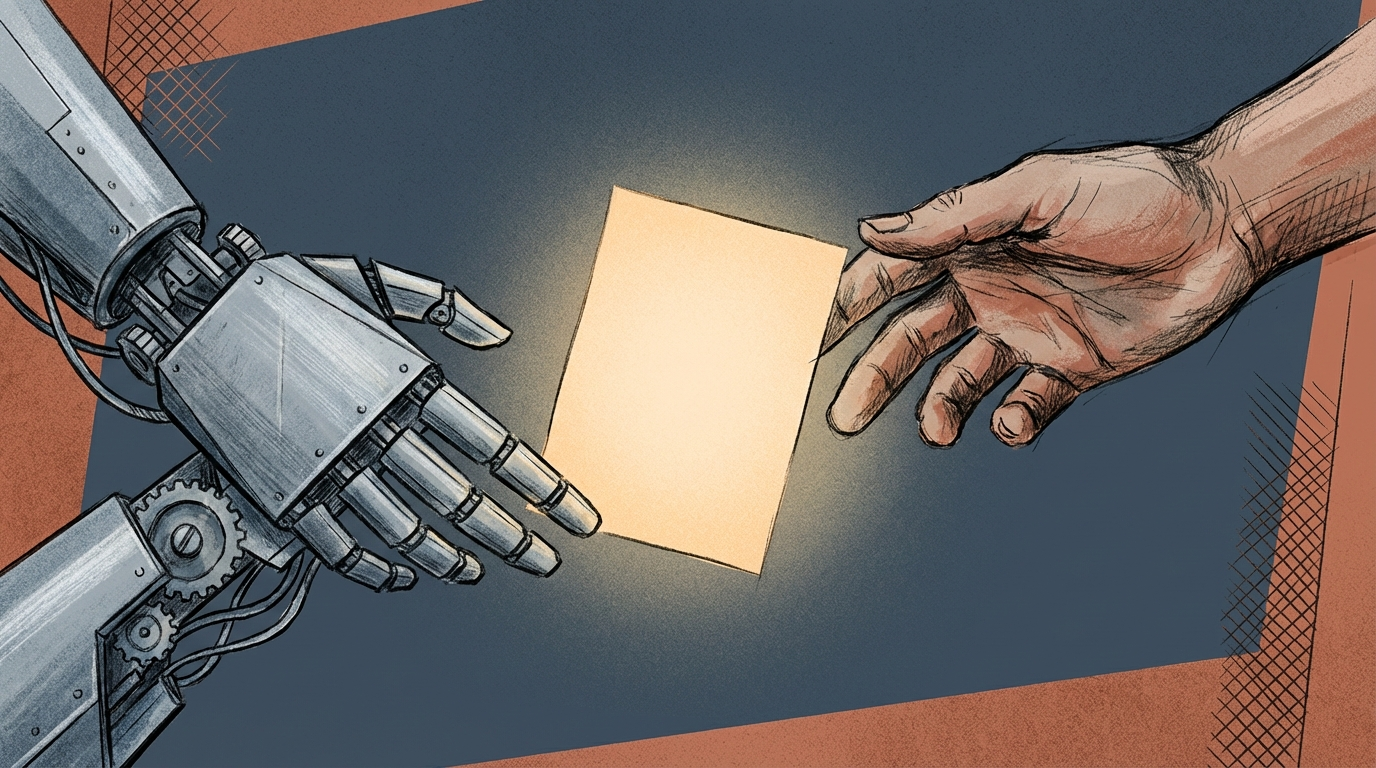
You can now generate a blog post faster than you can brief a freelancer. That sounds like progress until the draft confidently invents a statistic, misses your audience, and sounds like every other AI article on the internet. That's the real tension behind human in the loop AI content: marketers want the speed, but they can't afford the quality drop.
The mistake is treating this like a binary choice. It's not human writers versus AI tools. It's sloppy automation versus a smart workflow. The best setup lets AI do the heavy lifting while humans make the decisions that actually determine whether a post is worth publishing.
Since generative AI took off in 2023, too much of the conversation has centered on novelty. Can it write a post in 30 seconds? Can it publish automatically? Can it replace the team? Those are the wrong questions. The right one is simpler: does the output help a real reader and strengthen your brand?
That's where human oversight stops being a nice extra and becomes the whole game. Businesses that let AI publish directly to their blogs learned this the hard way, usually through factual errors, off-brand messaging, or content that looked polished but said nothing. The fix isn't to abandon AI. The fix is to put human judgment back in the places where it matters most.
The All-or-Nothing AI Content Trap
Most marketers are stuck between two bad options. On one side, there's the old manual process: slow, expensive, and hard to scale. On the other, there's fully automated publishing: fast, cheap, and risky in ways that can quietly damage search performance and brand trust.
That creates a false dilemma. Either keep doing everything by hand, or hand the keys to a machine and hope for the best. A lot of AI content hype has pushed people toward the second option by framing full automation as the obvious end state. It isn't.
The better model is more practical. Let AI handle the labor of drafting, organizing, and accelerating production. Keep humans responsible for the strategic calls AI is bad at: what angle to take, what claims need scrutiny, what tone fits the brand, and whether the piece deserves to go live at all.
Once you see the problem that way, the path gets clearer. The real risk isn't AI itself. The real risk is removing the checkpoints that protect quality.
What Google's 'Helpful Content' Guidelines Actually Say About AI

A lot of the fear around AI blogging comes from a misunderstanding of Google's position. Many marketers still assume Google penalizes content simply because AI was involved. That's not what Google's guidance says.
Google's public stance has been consistent on the core point: it rewards high-quality content, however it's produced. The method isn't the issue. The outcome is. If the article is useful, accurate, original enough to matter, and clearly built for people rather than search engines, AI assistance isn't automatically a problem.
What Google does target is content that feels engineered for rankings while offering little value to readers. Its Helpful Content System is designed to demote pages that appear written for search engines instead of humans. That applies whether the draft came from a person, a content farm, or a language model.
This is where a lot of AI workflows fail. They treat generation as the finish line. Enter a keyword, get 1,500 words, publish. That might produce something readable, but readability isn't the same as usefulness. A post can be grammatically clean and still fail because it lacks firsthand insight, repeats obvious points, or says nothing a dozen other pages haven't already said.
Google's E-E-A-T framework makes that gap even more obvious. Experience, Expertise, Authoritativeness, and Trustworthiness are hard to fake at scale. If your article includes real examples, careful fact-checking, a clear point of view, and signs that someone knowledgeable shaped it, it has a much better shot. If it reads like generic pattern-matching, it doesn't.
The real danger isn't using AI. It's using AI to skip the editorial work that makes content credible. Fact-checking, source review, angle selection, and brand alignment aren't optional cleanup tasks. They're the difference between content that helps and content that clutters the web.
A well-reviewed, AI-assisted article can rank just fine. In many cases, it should. But it has to earn that outcome the same way any good article does: by being genuinely useful to a human reader.
The Four Failure Points of Unsupervised AI Content
If you want to understand why approval checkpoints matter, look at what breaks when they're missing. Unsupervised AI content usually fails in familiar ways, and each one has a direct business cost.
1. Factual Errors and Hallucinations
The most obvious risk is the one people still underestimate. AI models can generate false information with total confidence. They invent statistics, misstate product details, blend sources together, and sometimes cite references that don't exist. The term AI hallucination is widely understood now because the problem is common enough to need a name.
For a blog, that's not a small quality issue. It's a trust issue. Publish one confident falsehood and readers start questioning everything else on the page. If the topic touches finance, health, law, or technical implementation, the damage gets worse fast.
A human review layer is what catches this. Not because humans are perfect, but because someone has to verify claims before they become public.
2. Brand and Tone Misalignment
Brand voice isn't "friendly but professional." That's prompt filler. Real brand voice includes your assumptions, your vocabulary, your standards, your sense of humor, and the stories you tell repeatedly because they matter to your audience.
Maybe your company has specific terminology customers already know. Maybe your founder always frames a problem from an operator's perspective. Maybe your audience responds to dry humor and hates inflated claims. AI can imitate surface style, but without supervision it tends to flatten all of that into generic internet prose.
That dilution is expensive. The more content you publish, the more your voice either compounds or disappears. If every post sounds interchangeable, your brand becomes interchangeable too.
3. Strategic Drift
This is the failure point people miss because the draft can still look good. AI doesn't understand your quarterly priorities unless you explicitly give them to it, and even then it doesn't actually care about them. It can't independently judge whether a topic supports pipeline goals, attracts the right buyer, or reinforces the message your team is trying to own.
So you get content that's technically competent and strategically useless. It targets broad traffic instead of qualified readers. It answers the wrong question. It pushes a message that doesn't match your offer. It fills the calendar without moving the business.
Don't confuse output with progress. If the article doesn't serve a defined purpose, speed just helps you miss the target faster.
4. The Uncanny Valley of AI Text
Then there's the subtler problem: text that feels almost right and slightly off. The sentences are clean, but too evenly shaped. The metaphors are odd. The transitions feel manufactured. The piece keeps circling obvious points with a polished, impersonal confidence.
Most readers won't say, "This was clearly written by a model." They'll just feel less trust. Something about it lacks texture. It has no lived detail, no sharp opinion, no sentence that sounds like a person who has actually done the work.
That matters because modern AI content often clears the minimum bar for readability. Its weakness isn't that it's unreadable. Its weakness is that it's forgettable, and just human enough to publish while still too thin to matter.
The Human-in-the-Loop Framework: Three Critical Checkpoints

The answer isn't making a human rewrite every sentence. That defeats the point. A good human-in-the-loop system concentrates human effort at the decisions that shape quality, while AI handles the drafting work that eats time.
Think of it as the 80/20 rule applied properly. AI does the production lift. Humans own the small number of decisions that determine whether the piece is strategically sound, distinct, and safe to publish.
Checkpoint 1: Strategic Direction
A human has to set the assignment. That means choosing the target keyword, defining the audience, and deciding what the piece is supposed to accomplish.
Is this article meant to capture top-of-funnel search traffic? Support product education? Build authority in a niche category? Drive demo sign-ups from comparison intent? AI can't infer that from a keyword alone.
This is also where topic ownership lives. Editorial direction should come from your team, not from whatever the tool decides is adjacent. If you don't choose the destination, the draft may be polished and still head in the wrong direction.
Checkpoint 2: Angle and Outline Approval
This is the highest-leverage checkpoint in the whole workflow. For almost any keyword, there are multiple valid articles you could write. One could be tactical. Another could be contrarian. Another could be beginner-focused. Another could be a product-led piece disguised as education.
The angle determines the value. It decides what argument the article makes, what examples it uses, what objections it addresses, and what kind of reader it will actually help.
That's why black-box tools are risky. If you enter a keyword and receive a finished article with no intermediate step, you're trusting the model to make editorial decisions that should belong to you. By the time you see the draft, the structure may already be wrong.
Approving the outline first fixes that. It gives the human a chance to reject a weak direction before the system spends time drafting 1,500 words around it. It also prevents a common waste pattern: editing a full draft that was built on a bad premise from the start.
A simple example: say your keyword is "customer onboarding email examples." One angle is a listicle for beginners. Another is a teardown of why most onboarding emails underperform after message two. If your product serves SaaS operators, the second angle is probably far more aligned with your audience and offer. AI can suggest both. A human should choose.
Checkpoint 3: Final Review and Polish
Once the draft exists, a human editor still needs the last word. This is where you catch factual mistakes, remove generic filler, tighten the logic, and restore the brand voice.
It's also where the article becomes yours. Add the anecdote from a client engagement. Insert the internal data point. Replace a vague claim with a concrete example. Cut the paragraph that sounds smart but says nothing. Make sure the piece flows like an argument, not a stitched-together summary.
This final pass isn't busywork. It's the quality gate. In an effective human in the loop AI content workflow, nothing publishes until a person has reviewed it and decided it reflects the brand well enough to stand behind publicly.
Putting It Into Practice: A Two-Checkpoint Workflow Example
Frameworks are useful, but workflows are what teams actually live with. This is where a tool like DraftSpring gets the model right.
The first checkpoint is angle approval. You give the tool a topic or keyword, and instead of immediately producing a full post, it generates several possible directions. Each option includes a working title, a thesis, and a structured outline. That gives the marketer something far more valuable than instant copy: a set of editorial choices.
The human then reviews those options and approves the one that best fits the strategy. If none of them are right, you redirect before any draft work happens. That alone prevents a huge amount of wasted effort. You never spend 20 minutes revising a full article that was built on the wrong angle in the first place.
Once the angle is approved, the second checkpoint kicks in. DraftSpring generates the draft from that specific blueprint, then hands it to the user in an editor for review and polish. The marketer can tighten claims, adjust tone, add examples, and make sure the piece is accurate before it goes live.
That's a much better use of AI. It removes the blank-page problem and cuts drafting time dramatically, while keeping the human in charge of the decisions that matter. The result is faster publishing without the black-box risk that comes from fully autonomous tools.
Your Best Content Strategist is Still Human
The future of content marketing isn't AI replacing humans. It's a partnership where each side does what it's actually good at. AI gives you speed, scale, and a way to get from idea to draft without burning hours. Humans bring strategy, judgment, empathy, and standards.
Take the human out completely and you don't get efficiency. You get a flood of generic content that weakens trust, blurs brand identity, and creates exactly the kind of low-value pages Google wants less of.
The marketers who win in 2026 won't be the ones publishing the most AI text. They'll be the ones running the best review process. They'll know how to use AI for speed without outsourcing editorial judgment to it.
If you're evaluating a writing tool this week, ask one question before anything else: where are the human checkpoints? If you can't approve the angle before the draft and review the final output before publishing, the tool is optimizing for speed at the expense of quality. That's a bad trade.
Choose the workflow that keeps a human in charge of what gets said and what gets published. If you want AI to strengthen your blog instead of dilute it, that's the standard worth holding.